
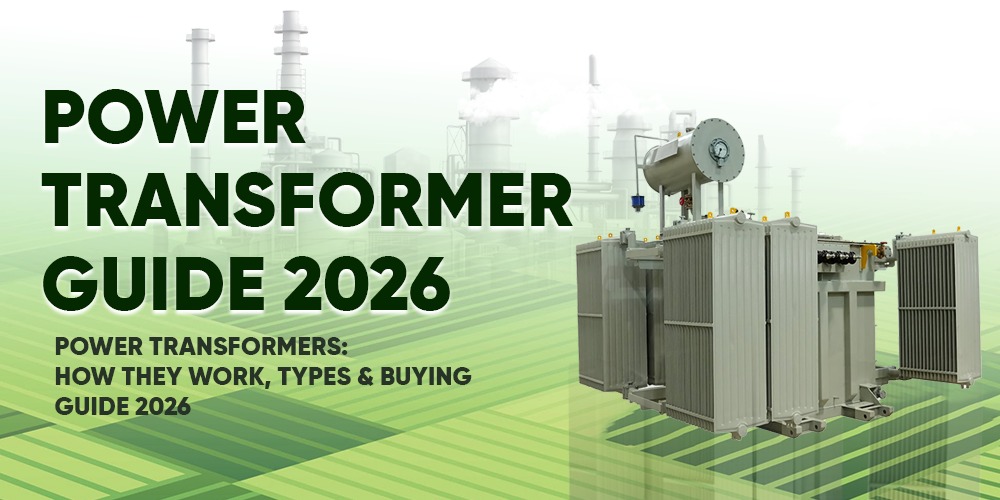
Power Transformers: Types, Uses, Working & Buyer’s Guide 2025
Learn everything about power transformershow they work, types, components, applications, and how to choose the right transformer for industrial or utility needs.
What Is a Power Transformer?
Power transformers are the backbone of electrical power systems. From high-voltage transmission lines to industrial plants, they make long-distance energy distribution possible by stepping up or stepping down voltage levels efficiently.
A power transformer’s job is simple but critical: transfer electrical power between circuits without changing frequency, while minimizing energy losses.
Whether you’re an engineer, industrial buyer, or curious learner, understanding power transformers is essential in today’s electrified world.
Why Power Transformers Matter:
Imagine trying to transmit electricity from a power plant to a distant city without stepping up voltage. The power loss would be so immense that most of the generated electricity would never reach the destination.
Here’s where power transformers save the day.
By increasing voltage, they reduce currentleading to dramatically lower transmission losses and more efficient power delivery.
How Power Transformers Work:
If you’ve ever wondered what happens inside a transformer’s metal box, here’s the simple answer:
Power transformers work using Faraday’s Law of Electromagnetic Induction.
Inside the transformer:
- The primary winding receives AC voltage.
- A magnetic flux forms in the core.
- The flux induces voltage in the secondary winding.
The voltage changes depending on the winding ratio:
- More turns in secondary = Step-up transformer
- More turns in primary = Step-down transformer
Key Components of a Power Transformer:
A high-quality power transformer contains:
- Core: Made of laminated silicon steel to reduce eddy currents.
- Windings: Copper or aluminum coils responsible for voltage conversion.
- Insulation: Paper, epoxy, or oil to prevent short-circuits.
- Conservator Tank: Holds extra insulating oil to manage expansion and contraction.
- Buchholz Relay: Critical safety device for detecting internal faults.
- Cooling System: Could be:
- ONAN (Oil Natural Air Natural)
- ONAF (Oil Natural Air Forced)
- OFAF (Oil Forced Air Forced)
7. Tap Changer: Allows fine adjustment of voltage levels.
Types of Power Transformers:
A. Core-Type Transformer
- Windings surround two limbs of a rectangular core
- Ideal for high-voltage applications
B. Shell-Type Transformer
- Core surrounds the windings
- Excellent short-circuit strength
- Often used in industrial machinery
C. Auto Transformer
- Shares part of its winding for primary and secondary
- High efficiency, compact design
D. Isolation Transformer
- Same voltage input/output
- Used for safety, noise reduction & sensitive electronics
Power Transformers vs. Distribution Transformers
This is one of the most searched topics among electrical professionals.
Power Transformer:
- High-voltage
- Used in transmission networks
- Operates at 100% load
- Higher efficiency
Distribution Transformer:
- Low-voltage
- Used near homes & businesses
- Operates at variable load
- Focus on minimum core losses
Applications of Power Transformers:
Power transformers touch almost every part of modern civilization.
Industrial Applications:
- Steel plants
- Cement industries
- Manufacturing units
- Data centers
Commercial Applications:
- Hospitals
- Shopping complexes
- Airports
- Corporate campuses
Utility/Grid Applications:
- Power plants
- High-voltage substations
- Transmission networks
Renewable Energy Applications:
- Solar farms
- Wind farms
- Hybrid grid systems
As renewable energy grows, transformer technology evolves with higher efficiency and smart-grid integration.
How to Choose the Right Power Transformer:
Here’s the section most buyers care about.
Choosing incorrectly can lead to overheating, failure, downtime, or excessive energy cost.
- Determine the Load Capacity
- Calculate kVA or MVA based on maximum demand.
- Select the Correct Voltage Rating
- Match system input and output requirements.
- Choose a Cooling Method:
- ONAN for low-cost standard applications
- ONAF or OFAF for high-load industrial use
- Consider Efficiency Ratings:
- High-efficiency transformers reduce lifetime operation cost.
- Evaluate Insulation Class:
- Oil-filled vs dry-type depends on environment.
- Safety Features:
Look for:
- Buchholz relay
- Temperature sensors
- Pressure Relief Device (PRD)
- Compliance & Certification:
Ensure compatibility with:
- IEC
- ANSI
- IS (Indian Standards)
- CE / UL
Latest Trends in Power Transformer Technology
- Smart Transformers:
- IoT-enabled units monitor performance and faults in real-time.
- Eco-Friendly Insulating Oils:
- Biodegradable ester-based oils reduce fire risk.
- High-Efficiency Amorphous Core:
- Cuts losses by 50–70% compared to traditional CRGO steel.
- HVDC Transformer Expansion:
- Supporting long-distance renewable energy transmission.
- Digital Twin Technology:
- Predicts failures before they happen using AI simulation.
Common Problems & Maintenance Tips:
Even durable transformers need care.
Common Problems
- Overheating
- Oil leakage
- Insulation breakdown
- Humming noise
- Short circuits
Maintenance Tips
- Regular oil testing (DGA analysis)
- Clean radiators
- Tighten connections
- Monitor temperature & vibration
- Annual professional inspection
A well-maintained transformer can last 30+ years.
Power transformers drive the energy systems that power our homes, industries, and future innovations. Whether you’re an electrical engineer, facility manager, or procurement professional, understanding transformer types, performance, and selection criteria helps you make reliable, cost-efficient decisions.
If you’re planning to purchase a power transformer or want expert guidance:

Leave a Reply
Want to join the discussion?Feel free to contribute!